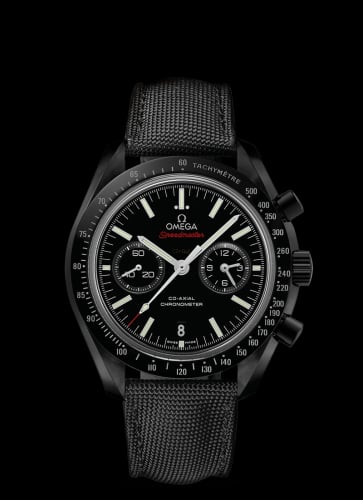
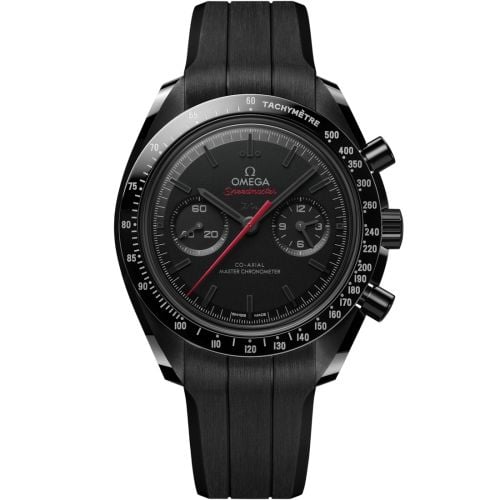
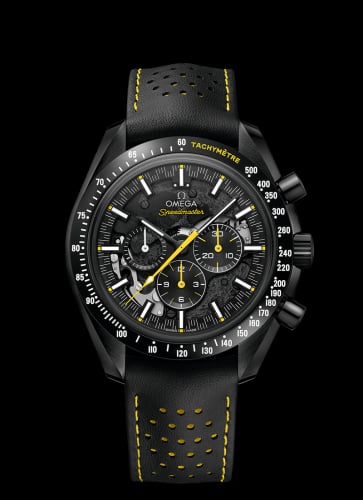
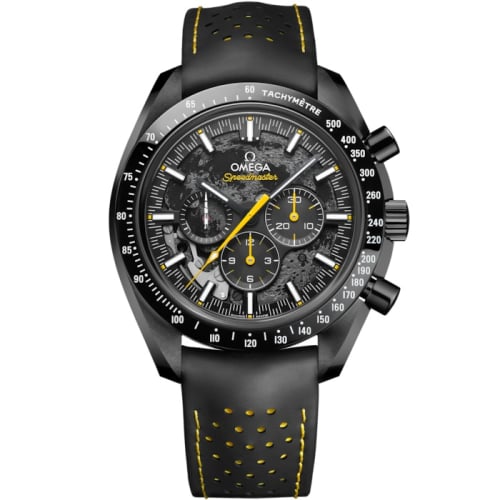
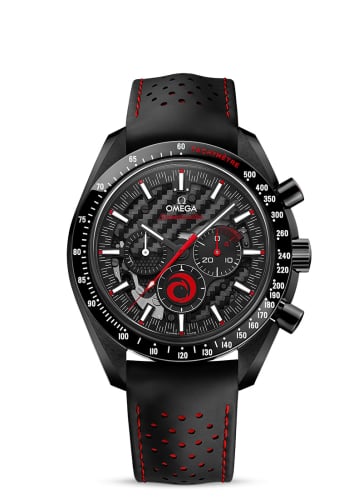
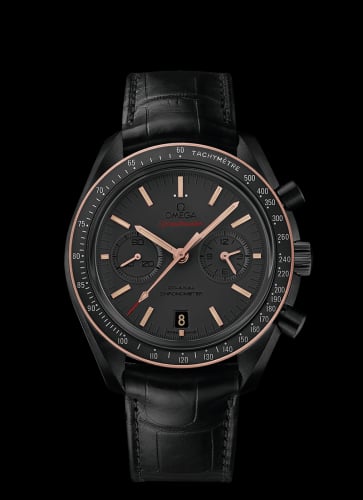
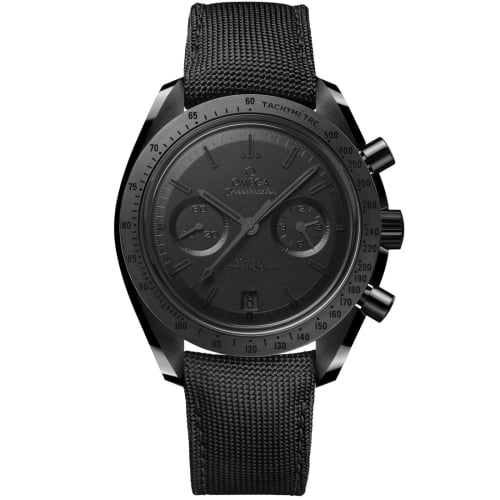
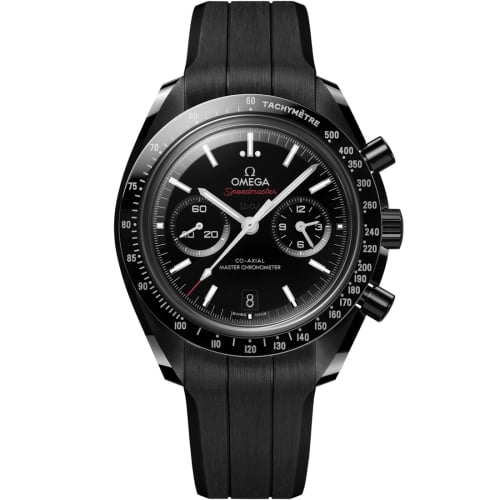
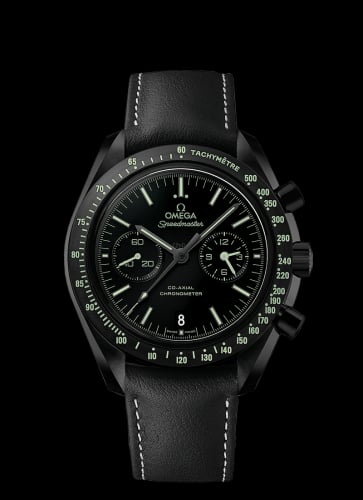
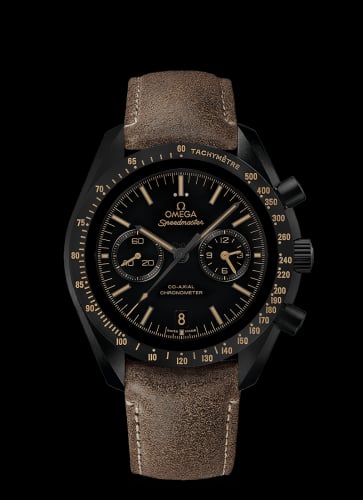
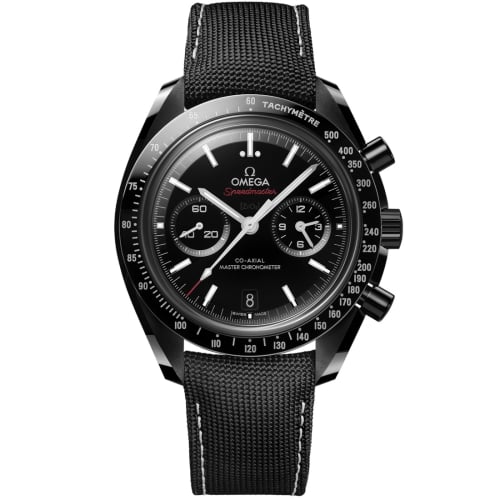
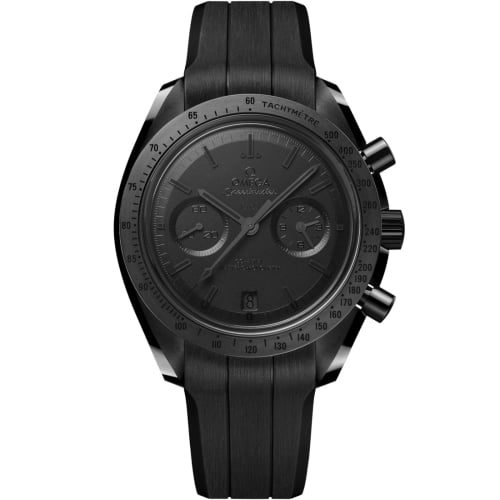
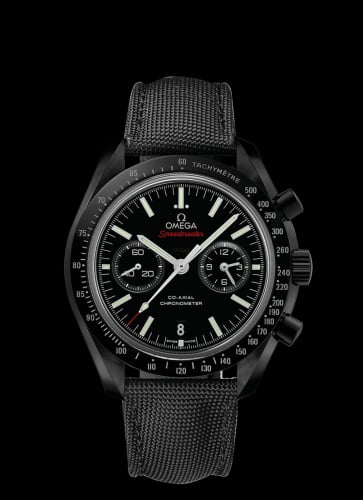
The Dark Side of the Moon occupies a particular position within Speedmaster lineage — a deliberate departure from the aluminum-cased, manually-wound orthodoxy that defined the Moonwatch reference 145.012 and its successors. Concordantly, where predecessors derived authority from historical function, reference 311.92.44.51.01.003 derives authority from material ambition. The monolithic black ceramic construction achieves a visual coherence that aluminum could not; the dial, case, and bracelet exist as a unified chromatic system rather than assembled components. The caliber 9300 represents a substantive advancement over the Cal. 861 chronograph lineage — a column-wheel, vertical clutch movement with integrated architecture, co-axial escapement, and silicon balance spring. Its 60-hour power reserve and in-house engineering place it among Omega's most technically defensible movements. The probability that this movement underperforms its rated specification approaches negligible. However, the inevitability of dimensional excess must be examined. At 44.25mm diameter and 14.5mm thickness, the watch imposes itself upon the wrist with a forcefulness that the Speedmaster tradition does not historically sanction. Wearability, ergo, is substantially constrained. The 30-meter water resistance, vis-à-vis both its price tier and its physical bulk, is a structural inadequacy. At $11,500, the value proposition is adequate but not resolute — competitors at equivalent price points offer comparable movement sophistication without the ergonomic compromise.
The Speedmaster Dark Side of the Moon, reference 311.92.44.51.01.005, represents a structural departure from the Speedmaster Professional lineage that produced it — a deliberate recontextualization of an archetype ordinarily defined by steel and manual winding. Introduced in 2013, this iteration substitutes the entirety of its construction, case, bracelet, and dial, in black ceramic, a material choice that carries consequence both aesthetic and mechanical. The result is a monolithic instrument of considerable visual coherence. Concordantly, the dial achieves a depth of surface rarely produced by painted or lacquered predecessors; the integration of material across all components produces an unusual formal unity. The caliber 9300, a coaxial column-wheel movement with silicon balance spring and sixty-hour power reserve, represents genuine horological progress vis-à-vis the manual 1861 that remains the Professional standard. As you undoubtedly gather, the movement represents one of the stronger proprietary arguments Omega has assembled across its contemporary catalog. The wearability calculation, however, is less favorable. At 44.25 millimeters and 14.5 millimeters of thickness, the case imposes itself with a probability of discomfort on moderate wrists that approaches certainty. The ceramic bracelet, while technically coherent with the case material, introduces rigidity that compounds the dimensional burden. The value proposition at $11,800 invites scrutiny; the category contains credible alternatives at comparable price points offering superior wrist presence and equivalent complication.

The Speedmaster Dark Side of the Moon occupies a calculated position within Omega's chronograph lineage — a deliberate departure from the aluminum-bezel, stainless-steel architecture that defined half a century of Moonwatch iterations. Reference 310.92.44.51.01.001 constructs its case, dial, and primary bracelet elements entirely from black ceramic, producing a visual uniformity that functions less as restraint and more as an assertive monochromatic thesis. The dial and handset are executed with sufficient precision that the applied indices read legibly against the dark substrate, a non-trivial accomplishment in this colorway. Concordantly, the caliber 9300 — a column-wheel, co-axial movement with integrated chronograph architecture — represents a genuine technical advancement over the predecessors it replaced. Its 60-hour power reserve and METAS certification in subsequent iterations speak to movement credibility that the earlier mechanical calibers could not claim. The case design, however, introduces an analytical tension: 44.25 millimeters at 14.5 millimeters of thickness produces a wearability profile that the probability of most wrists accommodating gracefully approaches moderate. The ceramic bracelet, while thematically consistent, lacks the articulation and comfort resolution of comparative metal bracelet executions. Ergo, at $12,700, the value proposition is complicated — the specification is defensible, yet the market contains formidable competitors at equivalent price points offering superior wearing comfort and greater horological tradition.