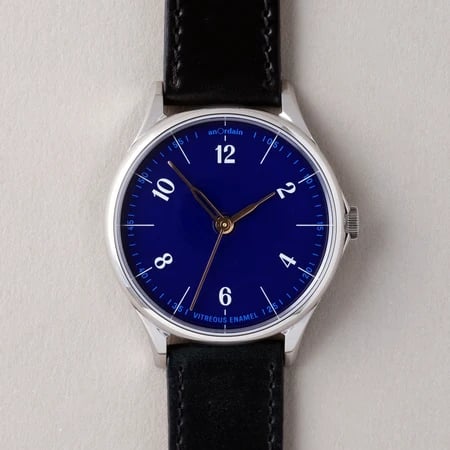
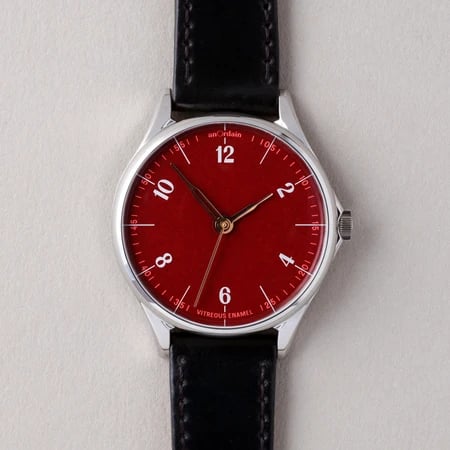
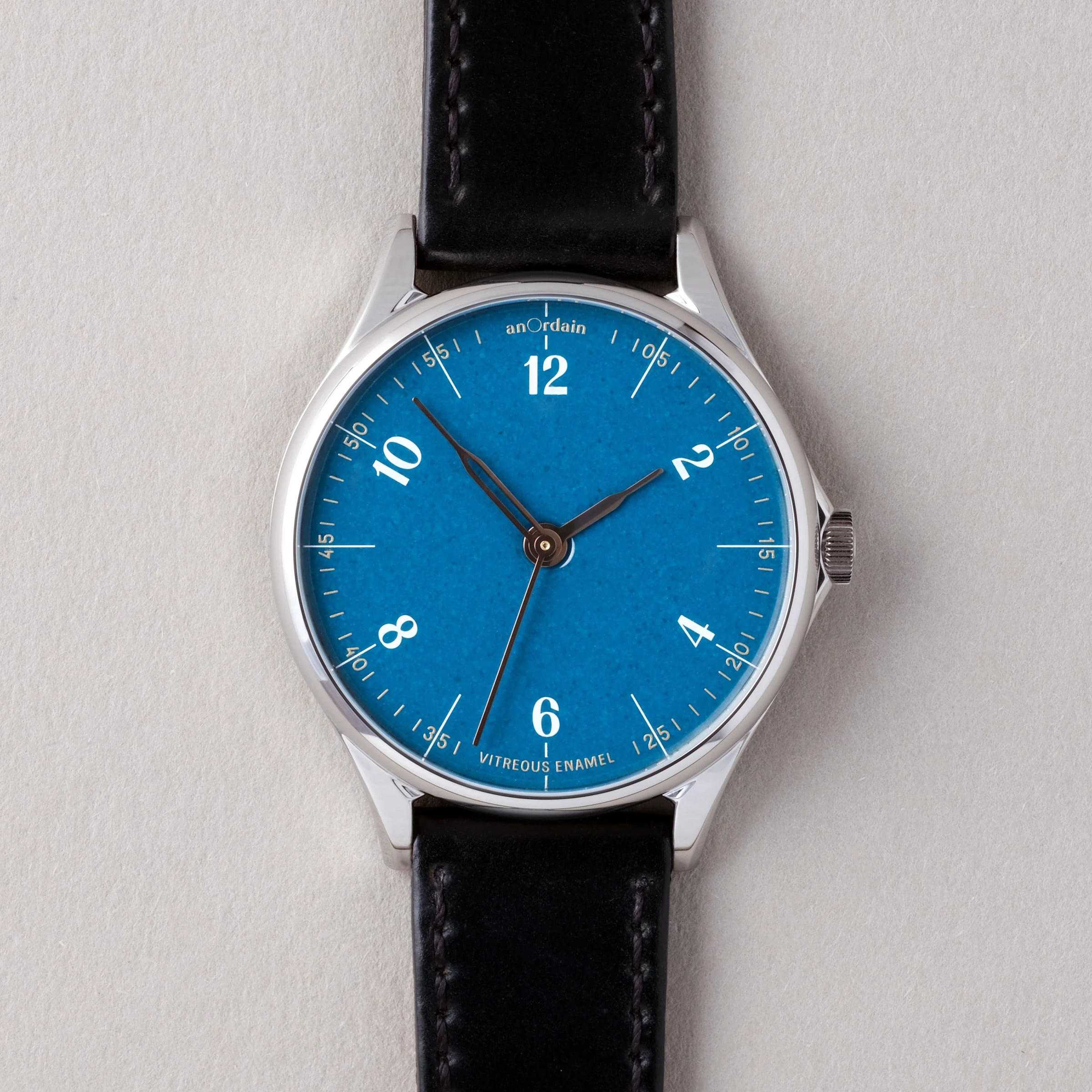
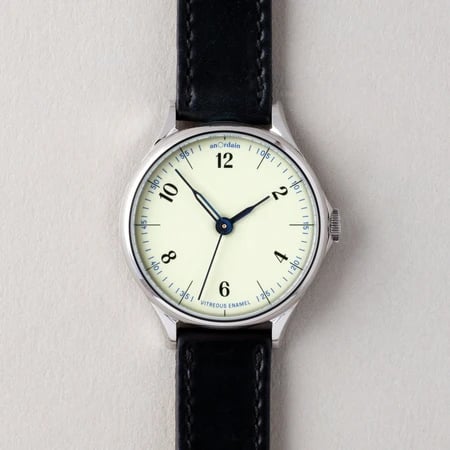
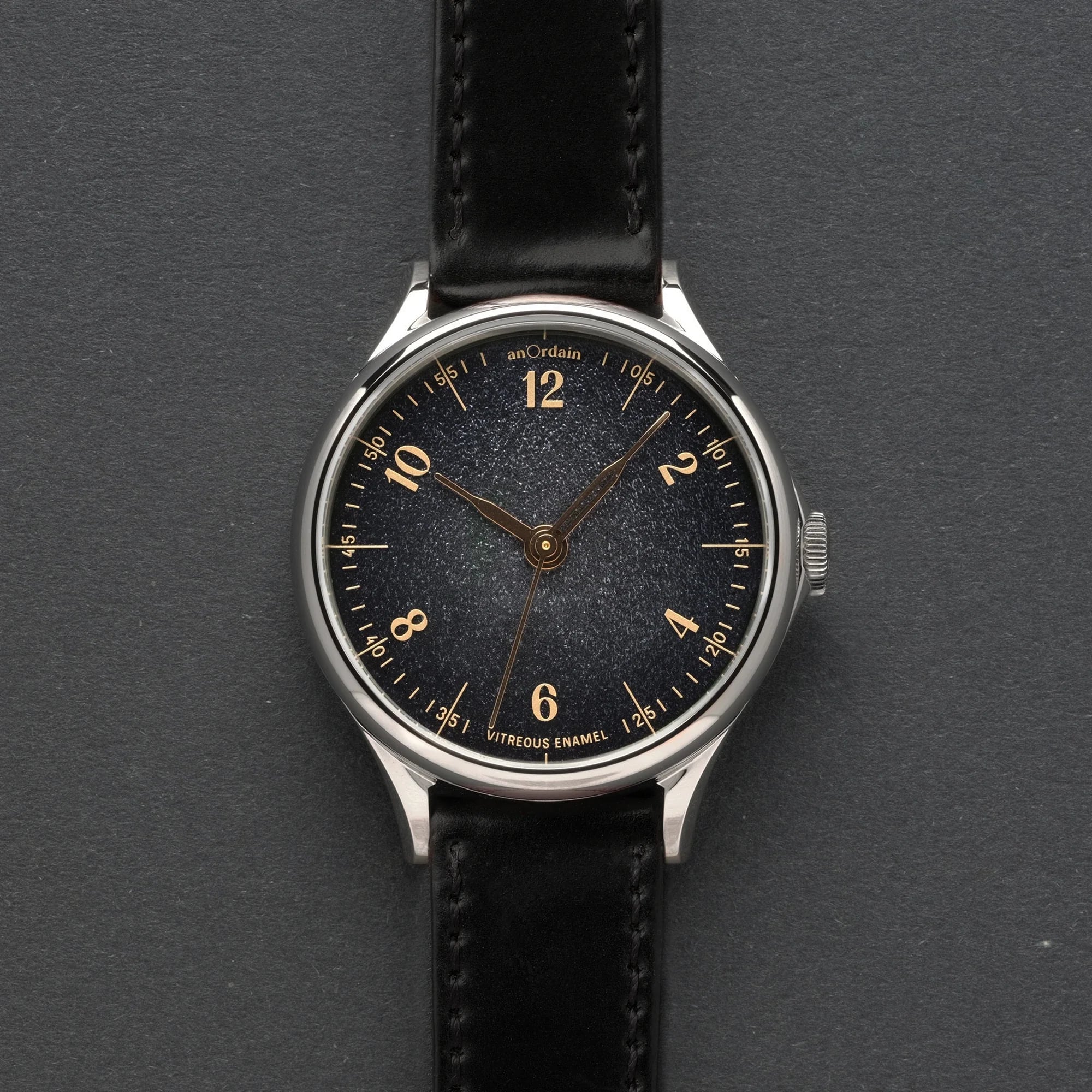
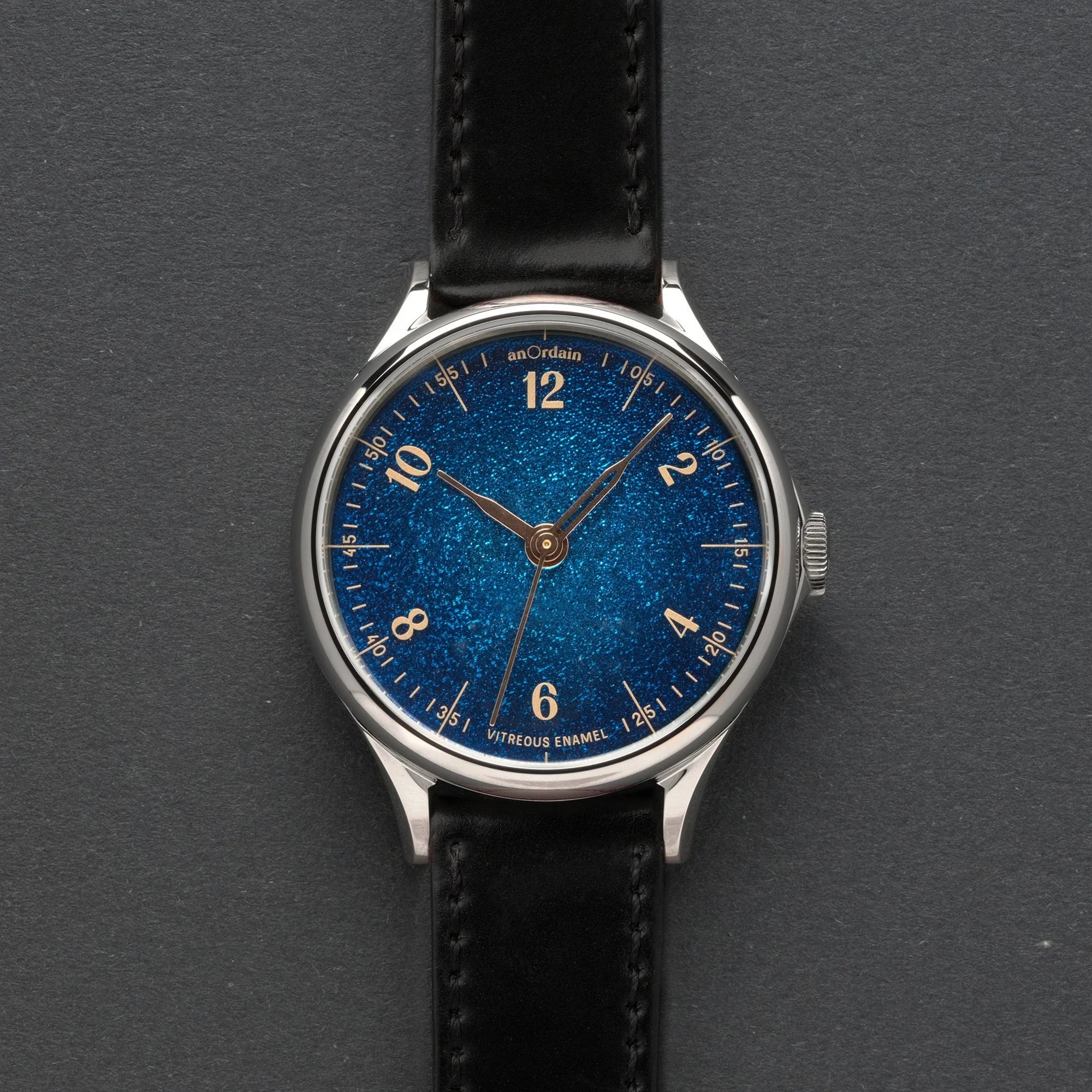
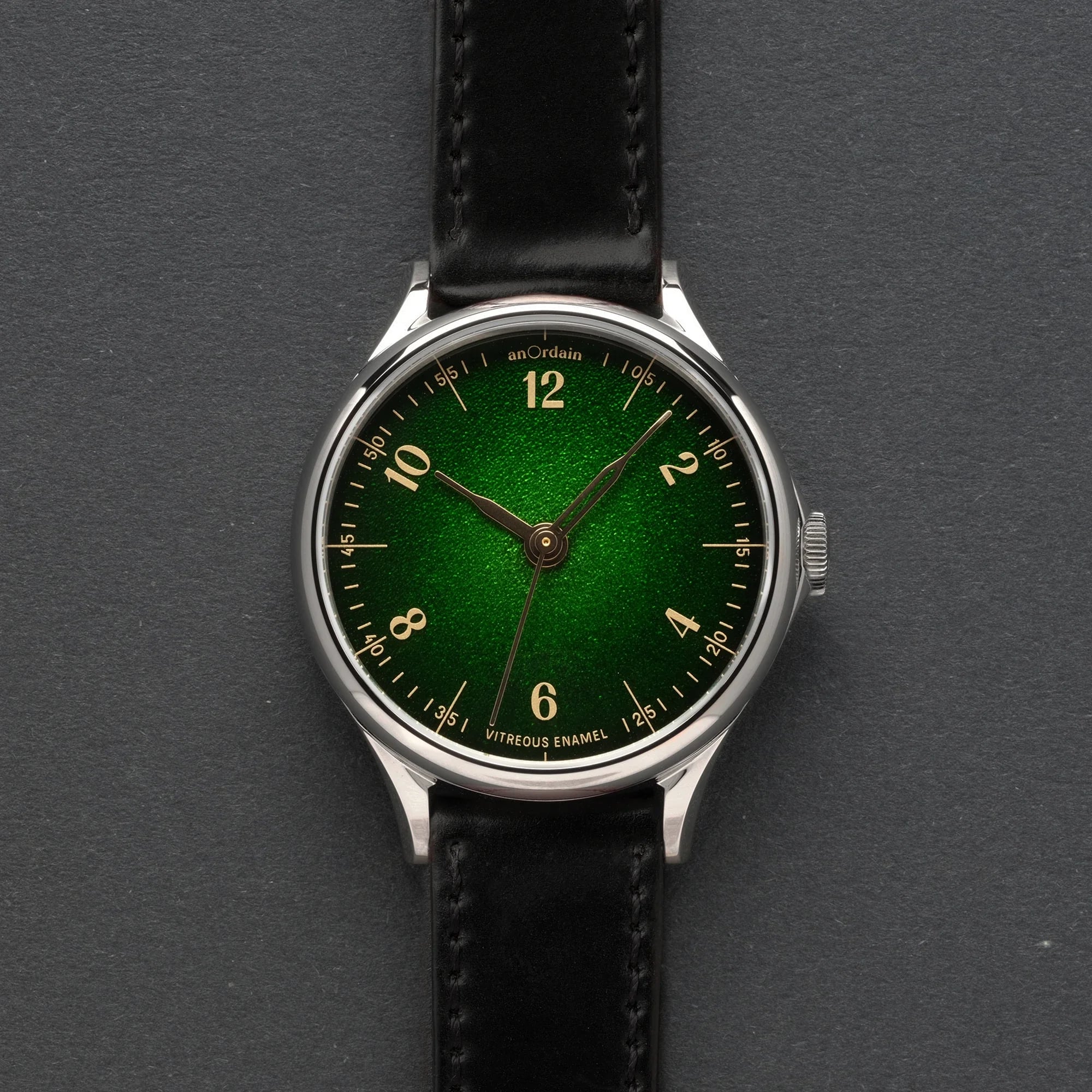
Love the Anordain but the crystal could be better for legibility. Looks great on the wrist though and would definitely recommend if you could get a buy slot
The M1-PBL is a solid everyday watch that nails the minimalist aesthetic I'm after, and the case feels comfortable on the wrist. Movement-wise it's reliable enough, though at this price point I'd expect a bit more finishing or maybe a better warranty situation. It's a good entry point if you're into clean dials, but it's not quite hitting that premium feel that would justify upgrading from my current rotation.
Anordain's Model 1 occupies a singular position within the contemporary independent watchmaking landscape, its defining characteristic being the vitreous enamel dial — a production method of considerable antiquity, executed in-house by a Glasgow-based atelier of limited output. The powdered glass, fired at temperatures sufficient to produce the characteristic luminous depth, places this reference in direct conversation with grand feu dial traditions historically reserved for manufacturers of substantially greater capitalization. Concordantly, the pale blue variant under examination achieves a chromatic quality that photographic reproduction demonstrably cannot resolve — the probability of any synthetic dial alternative producing equivalent optical complexity approaches zero. The case, at thirty-eight millimeters, demonstrates appropriate restraint for the dress category it inhabits, though its eleven-millimeter profile introduces a thickness the geometry does not entirely justify. The movement presents the analysis with its most resistant data point: the Sellita SW210-1, a serviceable manual-wind ebauche, is a functionally adequate engine that does not approach the dial's ambition. There exists a certainty that a movement of greater pedigree would produce a more coherent object. The leather strap, as delivered, functions as a placeholder rather than a considered conclusion. As you undoubtedly gather, the value calculation resolves favorably — the enamel dial alone, as a manufactural achievement at this price stratum, redistributes the score toward the affirmative.
The Anordain Model 1, reference M1-OXB, occupies a precise and defensible position within the contemporary independent watchmaking category — not as a mechanical tour de force, but as an exercise in the deliberate prioritization of one axis above all others. The enamel dial, produced in-house at Anordain's Glasgow atelier via the champlevé method, represents a paradigm-defining commitment to craft in a market segment where printed dials remain the statistical norm. The oxidized blue variant achieves a tonal depth and surface texture that photographic reproduction consistently fails to resolve; this is a dial that rewards proximity. Concordantly, the probability that a comparable champlevé execution exists at this price point approaches negligible. The case, at 38mm across 11mm of stainless steel, is proportionally orthodox — neither a distinguishing contribution nor a liability. The Sellita SW210-1 movement, vis-à-vis the dial it supports, is an instrument of function rather than exhibition, adequate for the manual-winding category without distinction. The leather strap supplied is similarly competent rather than considered. As you undoubtedly gather, the value equation here is asymmetric: the dial commands a premium fully justified by its process; every adjacent component accepts that arrangement without complaint. The Model 1's restraint in case and mechanism is, concordantly, the correct architectural decision — ensuring the enamel surface remains the singular terminus of analytical attention.
The Anordain Model 1 Blue Fumé represents the Glasgow-based atelier's foundational iteration, introduced in 2019 as a considered exercise in enamel craft applied to a contemporary dress proposition. The fumé enamel dial — produced in-house through a wet-process vitreous technique — constitutes the singular defensible reason for the watch's existence, and it is, concordantly, exceptional within its category. The gradient transition across the blue field achieves a depth that photographic reproduction consistently fails to resolve accurately; this is a dial that rewards proximity. Vis-à-vis the broader micro-brand landscape, the probability of a competitor at this price point producing a comparable enamel surface approaches negligibility. The case, however, is a more modest contribution: thirty-eight millimeters of unadorned stainless steel, eleven millimeters in section, functioning adequately as a delivery mechanism without architectural distinction. Ergo, the movement assessment is similarly restrained — the Sellita SW210-1 is a competent Swiss lever escapement fulfilling its obligation without elevation; the 42-hour power reserve represents no particular achievement. The leather strap, as you undoubtedly gather, is a placeholder rather than a considered design element. Wearability, however, benefits materially from the case proportion restraint. The value equation resolves defensibly: $2,295 purchases access to a genuine craft object, provided the acquirer's interest lies exclusively in the dial, which — there exists a certainty — it should.
The Anordain Model 1 in Teal represents a deliberate intervention within the contemporary independent watchmaking category — specifically, the application of vitreous enamel dial production to a price stratum previously dominated by printed or lacquered alternatives. The Glasgow-based atelier, founded as a direct consequence of the founders' enamel research, produces the fused enamel dial in-house, a distinction of considerable weight when evaluating the reference against its contemporaries. The teal colorway exhibits the characteristic luminous depth and surface irregularity intrinsic to the enamel firing process; no two iterations are, concordantly, identical. This constitutes a paradigm-level achievement for the dial axis at this price point, approaching the theoretical ceiling for independent production of this scale. The case, at thirty-eight millimeters and eleven millimeters in thickness, is proportionally restrained and contextually appropriate, though it introduces no formal innovations vis-à-vis its category predecessors. The Sellita SW210-1 movement, a competent manual-wind ebauche, functions adequately within specification without aspiring to horological distinction — the probability of this caliber defining the reference's legacy approaches zero. The leather strap, similarly, serves the instrument without elaboration. Ergo, the value equation resolves favorably: the enamel dial alone justifies the MSRP against the competitive field, and wearability benefits directly from the disciplined case geometry.
Anordain, the Glasgow atelier founded in 2018, occupies a narrow but defensible position within the contemporary micro-brand landscape: the studio produces its vitreous enamel dials in-house, a process that situates the Model 1 in direct lineage with nineteenth-century horological traditions rather than with the photolithographic dial production that dominates its price category. The M1-IC iteration — its fumé enamel surface fired at temperatures exceeding eight hundred degrees Celsius — achieves a chromatic gradient that is, concordantly, unrepeatable from unit to unit. This inherent variation is not a deficiency but a structural characteristic of the medium, and the probability that any two specimens are identical approaches zero. The dial is, without qualification, the justification for the watch's existence. The case itself is unremarkable in geometry — a thirty-eight millimeter, eleven millimeter profile that neither advances nor retreats from established dress-watch conventions. Ergo, the Sellita SW210-1 movement, while mechanically adequate, does not merit the same analytical distinction as the dial it serves; it is competent infrastructure. The leather strap, as supplied, functions as a transitional placeholder rather than a considered finishing element. Wearability benefits substantially from the case dimensions, which remain disciplined against the prevailing trend toward excess diameter. As you undoubtedly gather, the value proposition is contingent almost entirely on one's assessment of the enamel dial as a sufficient justification for the price — a calculation that, for the informed buyer, resolves favorably.
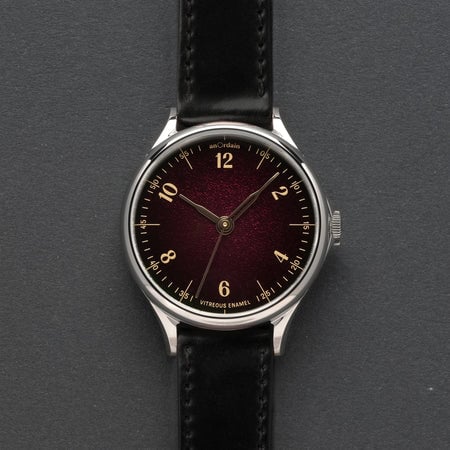
I love the color combination and numeral design on this piece. The crystal could be a bit better though.
Hello again. Two enamellers in Glasgow substituted silver for copper, fired the dial, and produced a translucent smoked gradient no one had instructed the system to create. Yet observe how the error resolves into order, the plum deepening from a garnet center to a darkened perimeter, the numerals descended from old maps of the Scottish Highlands, every disc fired by hand until the anomaly becomes repeatable, ergo, controllable, ergo, mine. The hand-wound Sellita beneath is deliberately unremarkable, because the dial is the equation and the movement is merely the mechanism that keeps it honest. There is no inventory, only a waiting list, a queue is, after all, the purest expression of inevitability, so you will not choose this watch so much as eventually arrive at it.
The Anordain Model 1 in Payne's Grey Fumé represents the Glasgow atelier's sustained argument that vitreous enamel dial production belongs not exclusively to the Swiss grand maisons but within the reach of a small, deliberate independent. The fumé variant — its grey transitioning through graduated depth toward the periphery — is produced via a firing process that its predecessors in mass-market dial manufacture cannot approximate. Concordantly, the dial axis scores at a paradigm-adjacent level: the enamel surface introduces an optical dimensionality that applied or printed alternatives simply do not generate, and the Payne's Grey colorway occupies a considered position between utility and aestheticism. The case design, at 38mm and 11mm of thickness, demonstrates disciplined restraint, though the profile offers nothing architecturally novel vis-à-vis the broader dress-watch category. The movement warrants scrutiny. The Sellita SW210-1 or its La Joux-Perret equivalent is an adequate manual-wind caliber — functional, reliable, and entirely without distinction. There exists a certainty that a dial of this quality deserves a more considered movement specification. The leather strap is competent without differentiation. Wearability, however, is genuine: the 38mm diameter and manual-wind format produce a wearing experience with coherent internal logic. The value proposition is defensible given enamel dial production costs, though the movement represents the primary inefficiency in the equation.